
-
Antique Art Nouveau Floral Bangle Bracelet 10k Rose Gold
Regular price $3,150.00Regular priceUnit price per -
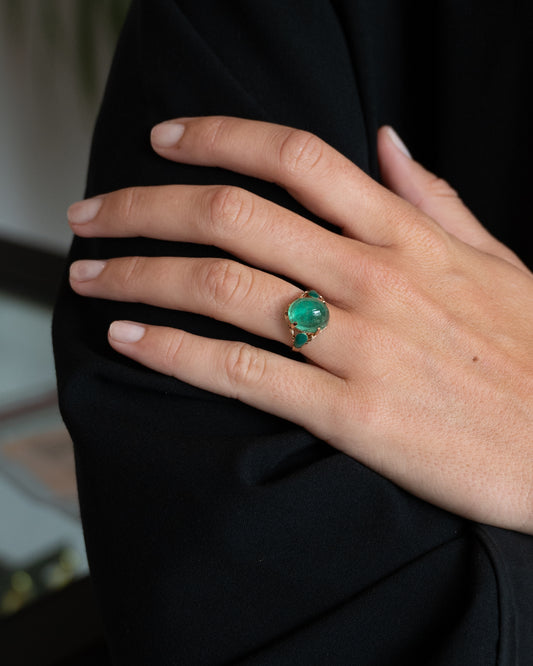
6.06 Antique Art Nouveau Emerald Cocktail Ring 18k
Regular price $5,900.00Regular priceUnit price per -
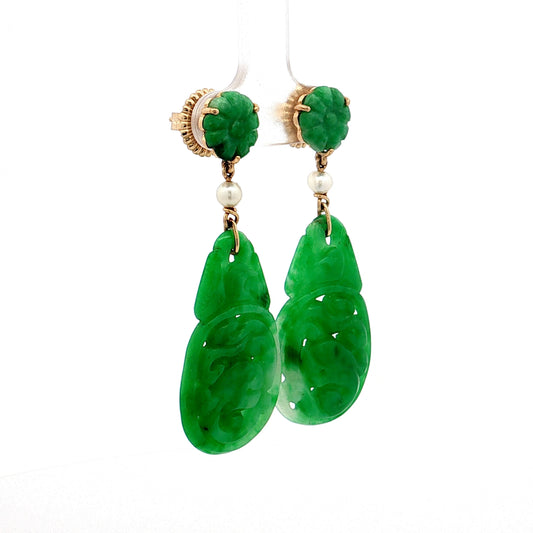
Antique Art Nouveau Jadeite & Pearl Drop Earrings 18k
Regular price $6,500.00Regular priceUnit price per -
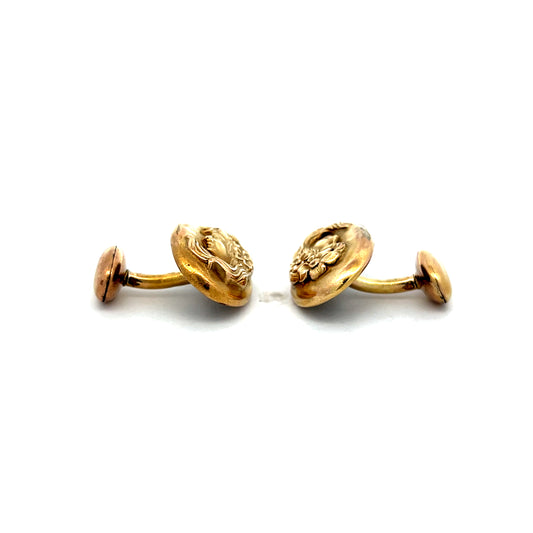
Antique Art Nouveau Cufflinks in 14k Yellow Gold
Regular price $950.00Regular priceUnit price per -
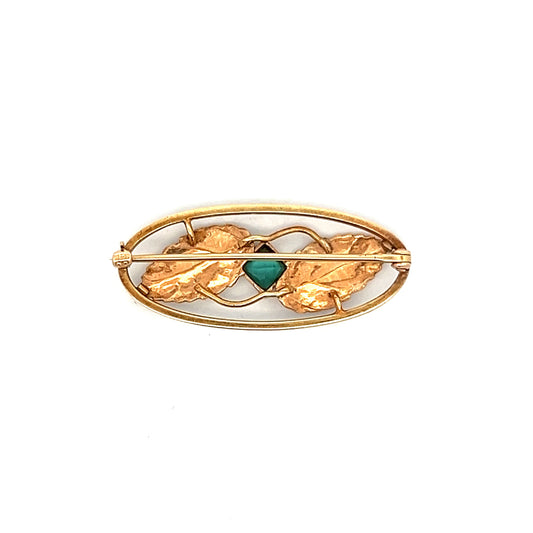
.35 Green Tourmaline Art Nouveau Brooch in 14k Yellow Gold
Regular price $900.00Regular priceUnit price per





FROM THE JOURNAL
Further reading

About
Art Nouveau Jewelry
Q: What defines Art Nouveau jewelry?
Art Nouveau jewelry is defined by organic, nature-derived forms and the whiplash line, an asymmetrical curve that mimics the growth of plants and the movement of water. Common motifs include the dragonfly, the serpent, the peacock, the iris and orchid, and the female figure with flowing hair. The metalwork is figurative and built to hide its own construction behind the illusion of something that grew on its own. Enamel is central to the period, and the materials favor color and luminosity, such as opal, moonstone, and horn, over gem weight. The movement runs from roughly 1890 to 1910.
Q: What is the difference between Art Nouveau and Art Deco jewelry?
The two movements are essentially opposites. Art Nouveau (1890 to 1910) emphasized flowing, organic forms inspired by nature, often rendered in enamel and soft-colored gemstones, and built by hand in small ateliers. Art Deco (1920 to 1935) rejected all of that in favor of straight lines, hard angles, geometric symmetry, and high-contrast color in platinum and white gold. Art Nouveau pieces look like they grew; Art Deco pieces look engineered. The Edwardian era (1901 to 1915) sits between them.
Q: What materials and gemstones are common in Art Nouveau jewelry?
Enamel is the signature material, worked most often in plique-à-jour (fired without a metal backing for a stained-glass effect) and champlevé (inlaid into recessed channels in the metal). For stones, the period favored opal and moonstone over diamonds, chosen for their inner glow rather than their hardness. Horn, ivory, and tortoiseshell appear for their warmth against the skin, and pieces are typically built in thin gold or silver wire in flowing openwork. One exception is the jeweler Henri Vever, who applied Art Nouveau forms to precious stones like rubies, emeralds, and sapphires where his contemporaries leaned on humbler materials.
Q: How can I tell if a piece of Art Nouveau jewelry is authentic?
Start with the line. Authentic Art Nouveau looks like it grew, with curves that flow into one another rather than meeting at angles or repeating in a geometric pattern. Enamel work, especially plique-à-jour, is a strong period marker, as are nature motifs rendered with anatomical care rather than stylized symmetry. Most genuine Art Nouveau in the estate market is unsigned, so a maker's mark is not required for authenticity; the quality of the execution is the real indicator. Hand fabrication shows in the openwork and the finishing. If you see geometric repetition or hard angles, the piece is more likely Edwardian or Art Deco.